
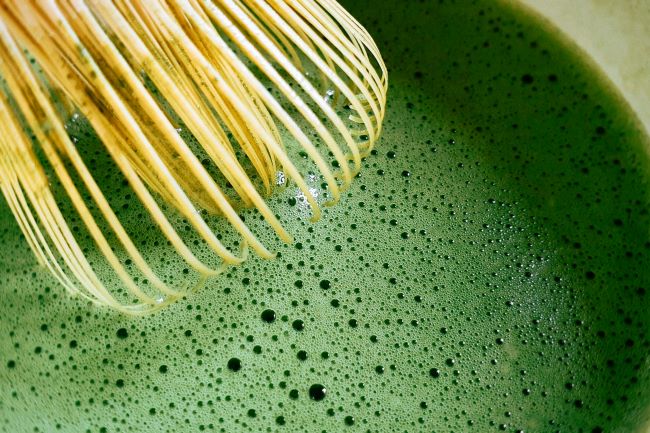
Matcha tea is easily recognizable by its vibrant green color.
Traditionally used in Japan during tea ceremonies as well as in pastries, it is now widely renowned for its antioxidant and anti-inflammatory properties.
However, matcha green tea powder offers many other health-promoting properties.
Matcha tea: nutritional composition
Matcha tea is derived from Tencha tea.
Its specific cultivation conditions shield it from direct sunlight. This shade-growing process enhances the concentration of chlorophyll and polyphenols (catechins) in its leaves, as well as L-theanine, caffeine, vitamin C, and many other bioactive compounds of high nutritional interest.
Following harvesting, Tencha leaves undergo gentle steaming to halt oxidation, followed by drying.
Once stems and veins are removed, the leaves are slowly stone-ground to yield the fine green powder characteristic of matcha tea.
Matcha tea: nutritional properties
Theanine
Present at approximately 20 mg / g of matcha tea, theanine is an amino acid that exerts a regulatory effect on the neurotransmitters serotonin and dopamine. It thereby promotes overall relaxation while improving sleep quality, concentration, memory, and alertness.
Catechins confer matcha tea its antioxidant properties. Notably, it contains epigallocatechin gallate (over 10 mg / g of matcha tea), which accounts for its high antioxidant capacity.
These catechins neutralize free radicals, contributing to anti-aging, anti-inflammatory, and liver detoxification effects.
Caffeine
Matcha tea contains an average of 30 mg / g of caffeine (theine), which acts as an antioxidant and complements catechins. It reduces chronic oxidative stress and the secretion of pro-inflammatory cytokines.
Phenolic acids are also antioxidants, with hypoglycemic and neuroprotective properties. They modulate lipid and carbohydrate metabolism, thereby contributing to weight management.
Rutin, an antioxidant, acts to protect blood vessels and the cardiovascular system. Like phenolic acids, it is thought to exhibit antidiabetic properties and prevent diabetic complications.
Quercetin
It acts synergistically with rutin on glycemic balance by improving insulin sensitivity. It also demonstrates neuroprotective activity.
Matcha tea is thus considered beneficial for:
- balancing blood glucose levels
- supporting weight loss
- enhancing cognitive functions such as memory, attention, alertness, and concentration
- relaxing the nervous system
- slowing down the effects of aging
- protecting the cardiovascular system
- supporting immune defenses
|| Discover matcha tea in our lemon – matcha protein bars with no added sugars.
|| Need more information about our matcha bars?[/vc_column_text][/vc_column][/vc_row]
Sources:
Molecules 2020 Dec 27;26(1):85
Curr. Pharm. Des. 2017;23:2876–2905
Oxid Med. Cell Longev. 2016;2016:2986796
J. Food Sci. 2018;83:2280–2287
Nutrients 2020 Nov 26;12(12):3639